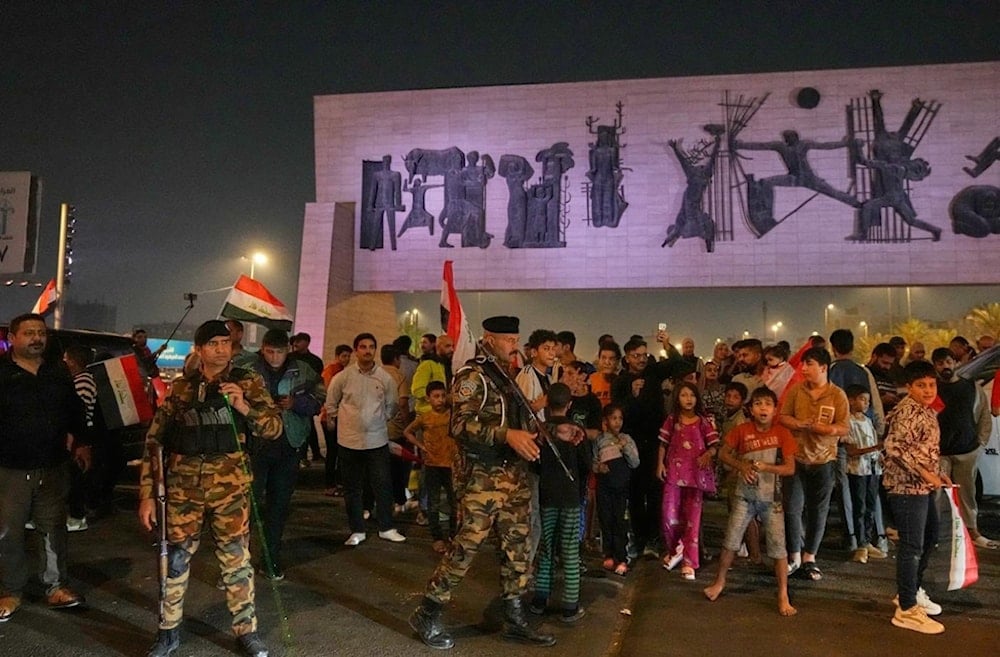
The Independent High Electoral Commission of Iraq announced the preliminary results of the parliamentary elections held last Tuesday and Sunday to elect members of the sixth legislative session of the Iraqi Parliament.
During a press conference held in Baghdad, the Commission revealed that the “Reconstruction and Development” coalition, led by Prime Minister Mohammed Shia al-Sudani, won in eight key governorates: Baghdad, Najaf, Qadisiyah, Karbala, Muthanna, Maysan, Dhi Qar, and Babylon. The Commission confirmed that the manual recount and sorting process was 100% identical to the electronic results.
Sudani’s coalition leads across key Iraq governorates following crucial pollshttps://t.co/Grip8G1qXx
— The Cradle (@TheCradleMedia) November 12, 2025
Commission members explained that the leading coalition in Baghdad came ahead of the “Progress” party, led by Mohammed al-Halbousi, which came in second. The “State of Law” coalition, led by Nouri al-Maliki, came in third, followed by the National State Forces Alliance, led by Ammar al-Hakim, then the Sadiqun Movement, the Azm Alliance, the Badr Organization, the Sovereignty Alliance, and the Iraqi Foundation Coalition. The remaining positions were distributed among new movements and entities such as “Rights,” “National Resolve,” “Good News for Iraq,” “Services,” “Ishraqat Kanoun,” “Al-Faw Zakho,” “The Alternative,” “National Depth,” and “The Saviors.”
In Nineveh, the Kurdistan Democratic Party (KDP) came in first, ahead of the Reconstruction and Development Coalition. The “Nineveh for Its People,” “Azm,” and “National Resolve” entities followed, along with several local alliances, most notably the “Arab Project” and the “Yazidi Cause.”
In the Kurdistan Region, the KDP reinforced its traditional position in the Erbil and Duhok governorates, while the Patriotic Union of Kurdistan (PUK) led the results in Sulaimaniyah, followed by the National Current, the New Generation Movement, and the Kurdistan Islamic Union.
In southern Iraq, the results showed a clear dominance of the Reconstruction and Development Coalition, which led in the Basra, Qadisiyah, Muthanna, Maysan, Dhi Qar, and Karbala governorates. It was followed, respectively, by the State of Law Coalition, the Sadiqun Movement, and the National State Forces Alliance. In Wasit, a local alliance called “Wasit, the Most Beautiful in Services” emerged as the top performer.
In the western provinces, the Progress Party, led by Halbousi, maintained its lead in Anbar and Salah al-Din, ahead of the Sudani Coalition and the Azm Alliance. The remaining blocs, despite their differences, occupied similar positions, reflecting the nature of the competition in these areas.
In Kirkuk, the Patriotic Union of Kurdistan (PUK) retained its first-place position, followed by the Progress Party, then the Turkmen Front and the Kurdistan Democratic Party (KDP), in a scenario that reinforces the multi-ethnic balance of power in the province. In Diyala, the Badr Organization led, followed by the Progress Party and then the Sovereignty Alliance.
The Independent High Electoral Commission (IHEC) confirmed that these results are preliminary and not final, noting that the appeals process will open after the official results are announced, in accordance with established legal frameworks. The IHEC emphasized that the electoral process was conducted with high transparency and professionalism, and that it “maintained impartiality towards all political forces.”
Source: Al-Manar